Ensemble Practice survey finds 4.3% client attrition at RIAs above $1 billion in 2023
Philip Palaveev contrasts 4.3% at the largest firms with 1.4% below $500 million and points to service by employees who hold no equity stake.

Philip Palaveev, whose firm Ensemble Practice ran the 2023 operating survey, reported in Financial Advisor Magazine on April 4 that client attrition ran from 1.4% at firms under $500 million to 3.3% at mid-sized firms and 4.3% at advisory firms above $1 billion in assets. He describes client and advisor turnover as surging to unprecedented levels at many of the country's leading RIA practices, and notes that the exodus comes right after a heavy stretch of investment and ownership transition across the industry. The direction of the gradient matters more to a seller than the absolute rate: the largest firms, the ones selling equity to outside buyers, are also the ones with the worst client losses.
The decade comparison gives the number a trajectory: in 2013 advisory firms added 12 clients for every hundred they already had and lost three, netting nine, while by 2023 additions had slipped to 11 per hundred and losses climbed to four, cutting net growth to seven. Palaveev reads that as an industry whose client acquisition engine is running about as hard as it did a decade ago, with the outflow the part that changed. The measurement lesson follows: a firm watching only net growth sees a decline from nine to seven and concludes it has a sales problem, and nothing in the survey says that happened.
Client losses concentrate above $1 billion
Not every departed relationship is a failure, as Palaveev is careful to say: firms routinely shed accounts too small to serve at a profit, clients whose expectations run past what the practice will deliver, and pairings undone by personality, so some turnover is healthy and some of it is chosen. For an owner preparing a sale, that split does real work, because deliberate culling improves the economics of what remains while unplanned losses show up in diligence as a question about next year's revenue rather than last year's.
His explanation for the size gradient turns on who does the serving: at the largest firms, he writes, clients are handled by employees who hold no stake in the organization, which is one survey author's causal claim rather than something the percentages establish on their own and should be weighed as such. The observation moves retention out of marketing and into the ownership structure, the part of an acquired firm that gets settled in the deal documents.
The survey does not test competing explanations for the gradient, and several would fit the same figures: whether the largest firms carry more clients obtained through transactions, more turnover in service roles, or more layers between the client and the person who owns the relationship, the coverage does not say. A seller sitting across from a buyer that has modeled attrition into a purchase price is entitled to ask which of those the buyer has assumed away.
What to count before a letter of intent
The comparison that matters most to a seller is the firm's own history rather than the 4.3% industry figure, and the survey's method suggests a presentation: gross additions and gross losses on separate lines, plus a split between relationships the firm chose to end and those it did not. An owner who can produce all three is describing a book a buyer can price, and the work required is a few hours with the client file.
Advisors working inside an acquired firm sit on the other side of the same question. The column's headline pairs advisor attrition with client attrition, though the figures in the available portion are client-side. If the stake of the servicing employee governs whether a relationship stays, as Palaveev's explanation implies, then retention of the people running the book runs through who holds equity in the new entity, settled while the deal is negotiated rather than in a staff meeting afterward.
An owner can run the sequence without hiring anyone. Measure outflow against the 4.3% for firms above $1 billion or the 1.4% for firms under $500 million, whichever band the practice sits in, then split losses by cause, and finally list the client-facing staff and mark who holds a stake and who does not, treating the second group as a retention budget rather than a footnote to the org chart.
The harder reading is about patience: attrition of 4.3% a year does not force a decision the way a failed deal or a lost team does, and Palaveev's own conclusion is that the industry is losing clients and advisors gradually rather than breaking suddenly. That makes the number easy to defer, which is how a management problem becomes the diligenced assumption sitting on the other side of the table, at which point leverage over the outcome has already moved.
The column's numbers make the case for looking before a sale rather than after one: 4.3% against 1.4%, and a net client growth rate that has given up two points in a decade. The published portion does not show whether advisor departures run along the same size gradient; if they do, the client-side leak is the smaller of the two problems for a firm whose owners have already sold.
Save this analysis and keep the funds you follow together in My Desk.
Sign in to save articles or follow funds.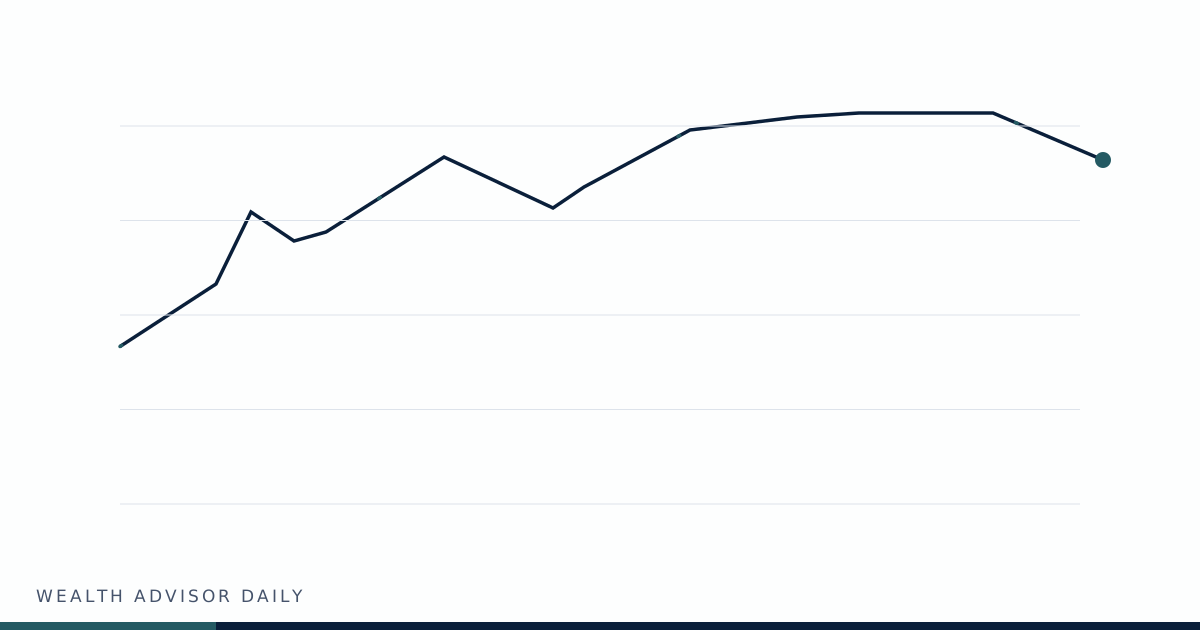 The Exit
The RIA deal dip is a seller's calendar problem
 The Advisor's Note
SEC proposes repealing two-year pay-to-play ban on government advisory work
 The Practice